Matt Kellner
The ShardsMatt Kellner is a student at Buckley whose reserve makes him difficult for his classmates to know, even as his relationship with Bret Ellis becomes one of the most intimate and consequential connections in the novel. His disappearance and death turn a private bond, concealed from their school community, into the focus of Bret’s attempt to reconstruct what happened and of the older narrator’s eventual return to the story. Matt is both a person Bret remembers through desire and friendship and a figure whose fate exposes how much the novel’s apparent mystery leaves unresolved.
Identity and Background
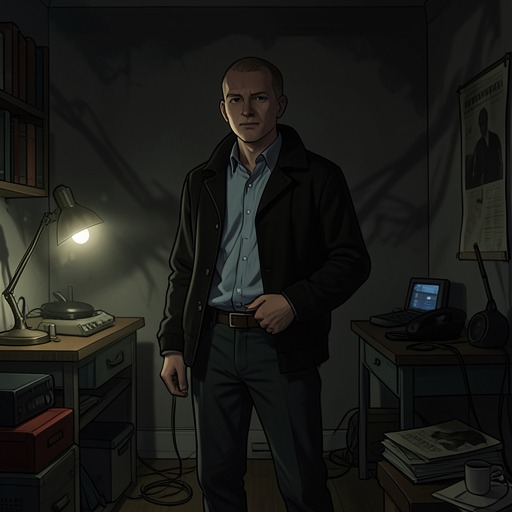
Matt is a tall, green-eyed Jewish student with a notably athletic build. Bret describes him as Buckley’s class stoner, but also as distant and difficult to reach: classmates might have found him popular had he acted more conventionally, yet his remoteness kept him outside the school’s usual social orbit. Bret imagines that Matt may have been profoundly wounded, but Matt does not disclose an explanation for his manner, so the source of that distance remains unknown.
Matt’s reserve contrasts with Buckley’s polished social hierarchies. The school’s uniforms and small classes are meant to restrain visible distinctions, but students still become objects of collective fascination. Matt’s attractiveness does not translate into broad popularity; he remains, in Bret’s view, intriguing precisely because he is hard to approach. His apparent self-containment is not explained away by the later revelations about his death, and the novel does not provide a complete account of his inner life.
Bret and Matt at Haskell Avenue
Bret begins visiting Matt’s family home on Haskell Avenue in Encino after they meet during Buckley’s summer program in July 1980. Both have failed Geometry and Science and attend morning classes so they can advance to eleventh grade. Their first conversations concern films and music: Matt asks whether Bret has seen Urban Cowboy, mentions an advance screening of Cheech and Chong’s Next Movie, and shares his enthusiasm for Lipps Inc.’s “Funkytown” and Queen’s The Game. He invites Bret over to swim and get high while his parents are away.
Their encounters grow increasingly direct and largely wordless. Bret recalls that conversation gives way to a familiar routine, while Matt appears comfortable with their physical closeness but not especially practiced at small talk. Bret’s later narration emphasizes how strongly he remembers Matt’s body and the access their intimacy gave him. That intensity is also a measure of what Bret has lost: decades later, Matt remains not merely a missing classmate but an intimate presence whose memory can still dominate the narrator’s attention.
The relationship is not openly acknowledged to their peers. When Thom Wright later expresses sympathy that Bret has lost a friend and admits he had not realized how close Bret and Matt were, he asks why Bret never told him. The exchange makes the secrecy plain without establishing that Bret and Matt had defined their connection in the same way. Matt’s feelings and understanding of the relationship are not fully available to the reader.
The Disappearance and Death
Matt’s absence becomes a mounting concern during the week he disappears. At lunch, Susan Reynolds tells the group that he is officially missing after meeting privately with Dr. Croft and Headmaster Walters. Bret fixates on the qualification officially, hearing it as an inadequate label for a frightening uncertainty. His concern is sharpened by their closeness, which he has not told his friends about.
Earlier warning signs at Matt’s house acquire a different weight after his disappearance. Bret finds the aquarium still lit but empty, its cover gone and filters switched off; Matt also reports that the cat is missing. Later, a gardener discovers Matt’s body in the pool at the Haskell Avenue home, while the missing cat’s head has been placed nearby. The discovery confirms that Matt is dead and that the disappearance involved deliberate violence and staging, not a simple unexplained absence.
Photographs shown to Bret by Matt’s father, Ronald Kellner, document bruising across Matt’s body. Bret recognizes the body with the painful intimacy of someone who had known him physically, while the photographs give material form to the gap between the Matt he remembers and the circumstances of his death. The official account does not, in the evidence presented here, resolve who inflicted the injuries or explain every part of the crime scene.
Bret’s Reconstruction and the Recording
Bret comes to believe that Robert Mallory was involved in Matt’s final week. He recalls seeing Robert and Matt speaking beside Matt’s red Datsun 280ZX, an encounter that had seemed unlikely to him at the time. Later, Bret confronts Matt about that conversation, asking what he and Robert discussed; Matt responds that what happened between Bret and him had never been serious and asks what Bret is doing. The exchange marks a rupture between them, but does not disclose what Matt said to Robert or establish what Robert intended.
A recording associated with Matt’s last night becomes central to Bret’s accusation. Listening to it, Bret identifies his aquarium fish in the scene and understands that the other voice is forcing Matt through a frightening ordeal. He also realizes that the recording refers to Matt having sex with a man and that the man meant is Bret. In a later confrontation, Bret tells Abigail Mallory that he believes Robert was the other voice and helped kill Matt. He advances a detailed theory involving a house in Benedict Canyon, drugs, a trip to Crystal Cove, Matt’s car, and the staged death in the pool. These are Bret’s conclusions, not a neutral narration confirming every alleged action.
Bret’s suspicions also connect Matt’s case to Katherine Latchford, whom he identifies as the Trawler’s first victim and says Robert had dated. Yet the account of the Trawler’s crimes does not confirm Matt as a victim, and a report discussed in the novel does not mention him or any male victims. The overlap raises the possibility of a larger pattern without resolving whether Matt’s death belongs to it. Matt remains at the intersection of two mysteries—Robert’s alleged conduct and the Trawler’s crimes—whose relationship is never made fully certain.
Memory, Secrecy, and Narrative Role
Matt’s story is shaped by belated recognition. Bret’s classmates do not know how close the two boys were, Matt does not explain the nature of his conversation with Robert, and the evidence surrounding his death leaves room between what Bret believes and what can be established. The novel does not repair these absences with an authoritative account of Matt’s thoughts. Instead, his life reaches the reader through remembered encounters, missing objects, photographs, a recording, and Bret’s increasingly urgent interpretation of them.
The older Bret eventually says that the book he began writing again was no longer primarily about the Trawler and the attacks but about Matt, whose memory followed him through ordinary present-day settings and into dreams. He recalls the summer encounter at Haskell Avenue, their intimacy, and the last time he spoke to Matt, which appears among photographs sent to him. The retrospective shift gives Matt a renewed centrality: the mystery is not only who caused his death, but why the remembered person has remained so powerfully present to the survivor.
That recollection sits beside Bret’s memories of other concealed or deferred desires. He describes his attachment to Thom Wright and later reflects on the secrecy surrounding his connection with Ryan Vaughn, whose plan was to leave Los Angeles and begin again elsewhere. These relationships do not make Matt’s experience interchangeable with theirs; rather, they place his hidden bond with Bret within a school culture where such intimacy is not openly recognized. In the final shape of Bret’s account, Matt is not just a clue in a crime narrative. He is the lost person whose particularity forces the narrator to return to the past, while the unanswered questions about his death keep that return incomplete.